
A fitting caked with dried grease, mud, or grit will not accept a grease gun cleanly, and forcing the coupler onto it pushes that debris straight into the joint. A zerk fitting is a small threaded lubrication port with a spring-loaded check ball inside; the coupler is the spring-loaded collar on the grease gun hose that clamps onto the fitting head. Cleaning the fitting before you couple up takes a few minutes and gives you a fitting that takes grease on the first pump without carrying grit into the bearing. The stakes are documented: SKF’s bearing-life analysis puts 36% of premature failures on poor lubrication and at least 14% on contamination, with the combined share rising above 50%. Purdue Extension’s rule is blunt: clean the fitting before you attach the gun, or the gun’s pressure will push the dirt in.
Key Takeaways
- Wipe, brush, wipe dry, then pick the check-ball recess, in that order, before the coupler goes on.
- Both sealing surfaces matter: the coupler jaws and the fitting bullneck. A dirty bullneck is why a gun weeps grease around the coupler instead of pumping.
- A fitting that will not take grease is usually clogged or has a stuck ball, not dead. Clean it first, replace it only if cleaning fails.
- Compressed air for cleaning is capped at less than 30 psi under OSHA 1910.242(b), and never on people or clothing.
- Caps and a regular schedule keep fittings clean between services, but caps degrade and need inspection.
How to Clean Dirty Zerk Fittings Before Greasing: The Short Answer
Work the fitting in this order: wipe, brush, wipe dry, then pick the check-ball recess. Engineer Fix’s cleaning procedure starts with a clean rag over the fitting and the area around it to lift loose dirt and surface grease, then a stiff wire brush, with penetrating oil or solvent on the brush for caked deposits. Wipe the loosened debris off with a dry cloth so no solvent residue remains, then scrape the small recess around the check ball with a pointed tool, carefully, so you do not scratch the ball or bend the spring. Only then does the coupler go on. Purdue Extension states the reason for the order plainly: clean the fitting before you attach the gun, because the pressure from the gun can force debris into the grease channel and cause significant wear on moving parts.
Key Takeaway: Clean, dry, then couple. Debris left on the fitting rides into the joint on the first pump.
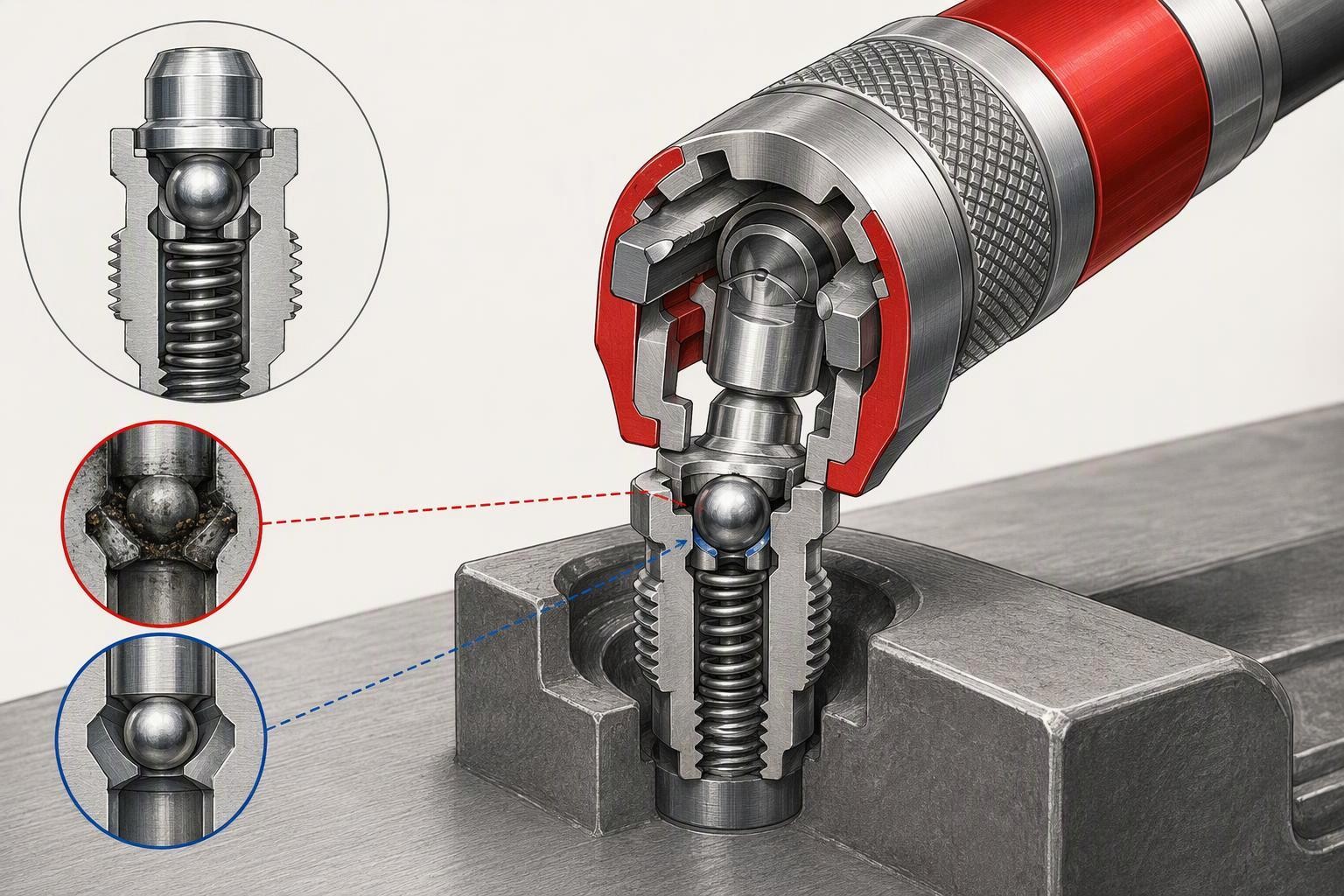
What Is a Zerk Fitting, and What Does It Look Like Inside?
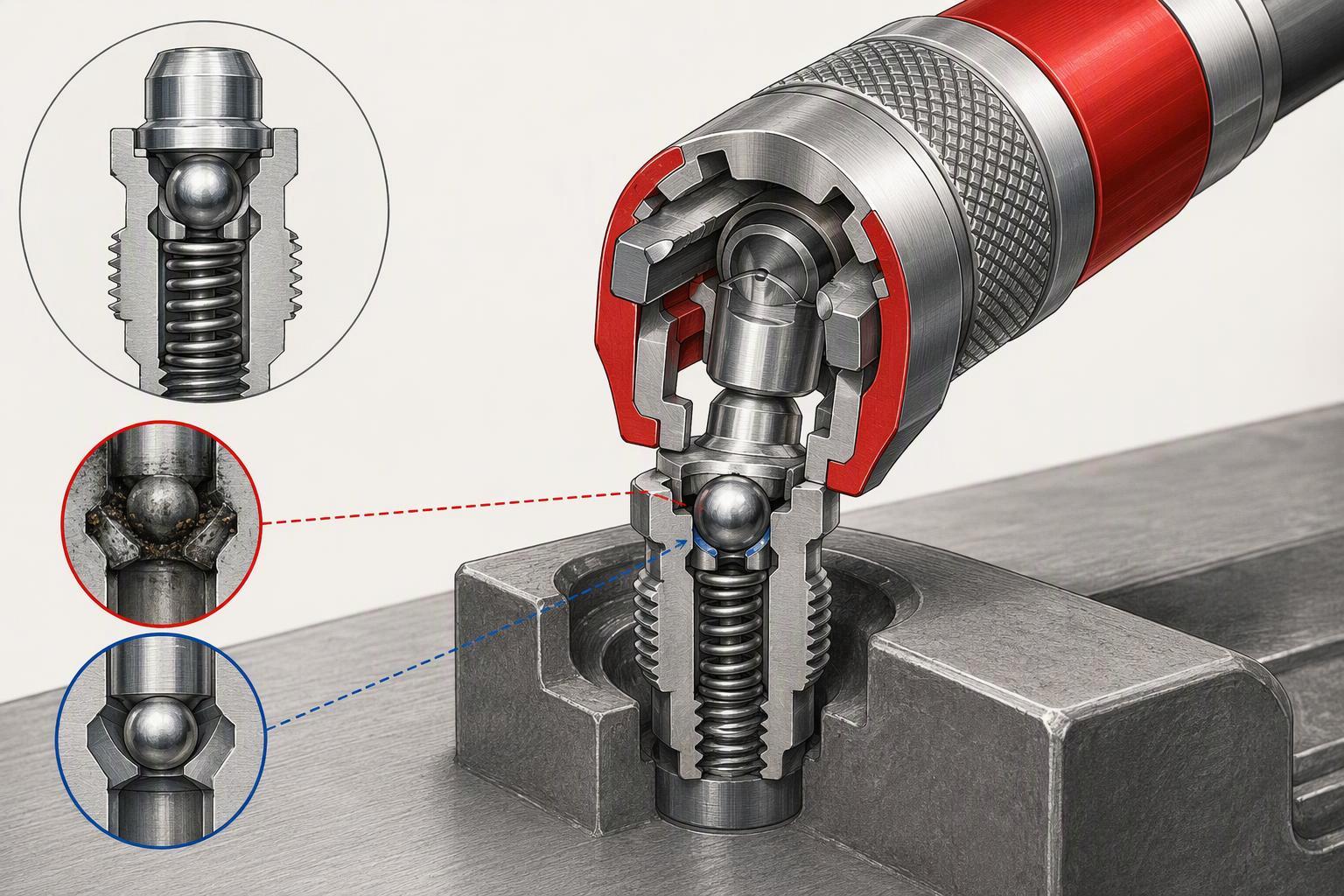
Engineer Fix’s anatomy description matches the patent: the coupler pushes the ball off its seat under pressure, grease flows in, and the spring re-seats the ball so grease and contaminants cannot flow back out. The industry standard for grease fittings, SAE J534, issued in 1949 and revised in October 2021, requires all standard hydraulic lubrication fittings to be supplied with check valves and states that valveless fittings are not recommended by the lubrication fitting industry. Externally the common forms are straight, 45 degree and 90 degree, with 30, 65 and 67.5 degree variants also catalogued.
| Thread | Region and typical use |
|---|---|
| 1/4-28 UNF | North American default for automotive and industrial points |
| 1/8 NPT | Tapered pipe-thread lubrication ports |
| M6x1.0 | Standard metric automotive and light industrial |
| M10x1.5 | Construction and mobile equipment |
isohitech’s size chart lists 1/4-28 UNF as the North American default with M6 and M10 in Europe and Asia, and rates carbon-steel fittings to 8,000 psi (550 bar) against 3,000 psi (207 bar) for brass.
Why Does a Dirty Fitting Cause Problems Before Greasing?
Grease carries about 80% of rolling element bearings, which is why a dirty fitting matters so much.The only way to detect it is to flush the bearing with new grease or remove it from service.
Purdue Extension’s rule is blunt about the mechanism: if you place a grease gun over a dirty fitting, the pressure from the gun can force the debris into the channel and cause significant wear problems for moving parts. Purdue’s guidance adds that pushed contaminants reach the metal-to-metal contact area, reducing remaining bushing and bearing life, and that contamination concentrates stress at surface roughness, which can lead to component breakage and premature bearing failure. The SKF split quantifies the stake: 36% of premature failures from poor lubrication, at least 14% from contamination, above 50% combined.
What Tools and Materials Do I Need to Clean a Zerk Fitting?
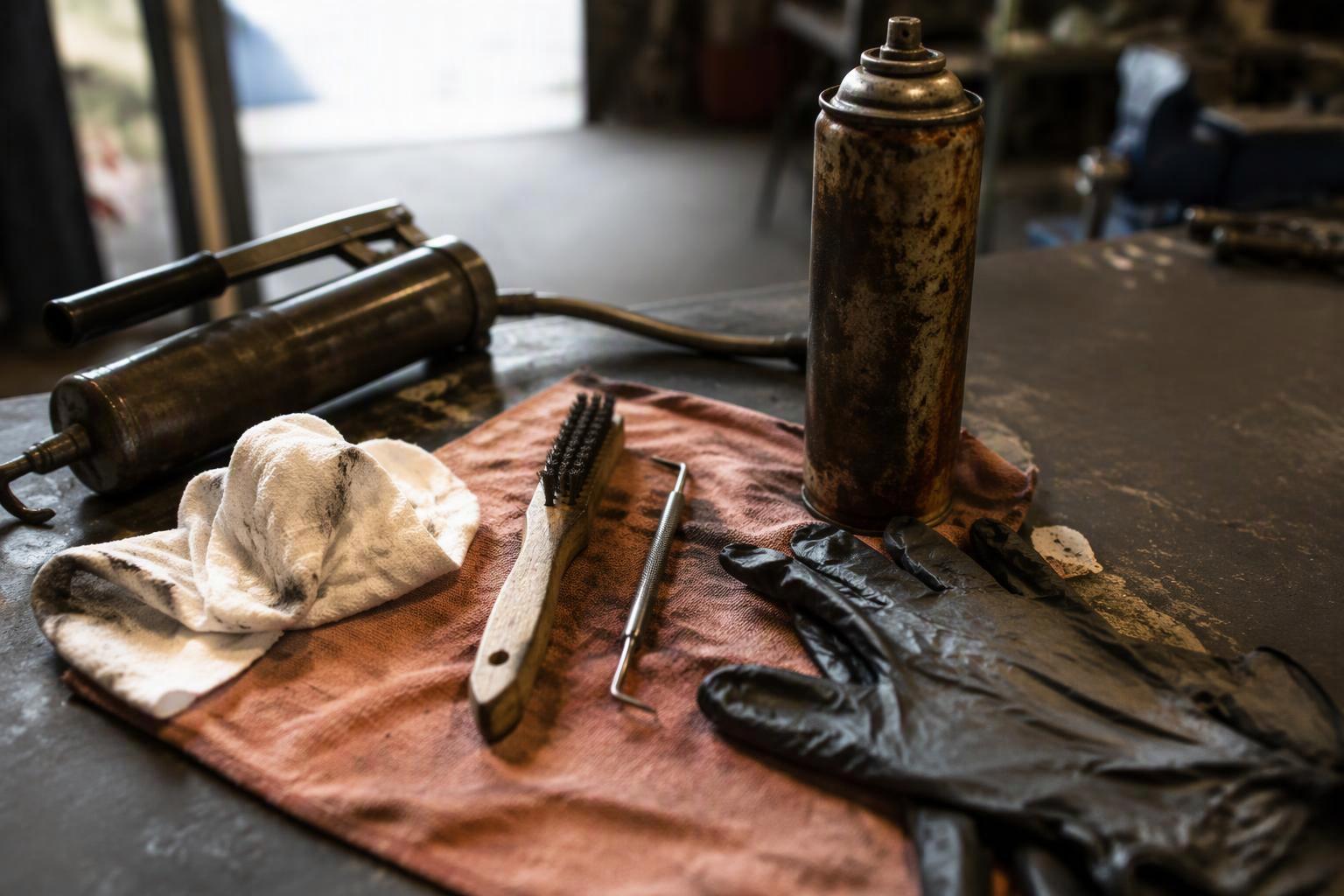
The baseline kit is a clean rag or lint-free shop towel, a stiff wire brush, a pointed pick, and penetrating oil or solvent. Engineer Fix’s cleaning guide specifies the brush for caked-on deposits and hardened grease, solvent on the brush for the worst of it, and a thin nail or dental pick for the recessed opening at the check ball. Purdue Extension keeps it simpler: a clean rag or shop towel will do, and it prescribes wiping the fitting and the hose end before pumping.
For hardened plugs, a fitting cleaner filled with penetrating oil, tapped rather than hammered, is the next step up. Engineer Fix’s tool guide describes the device: its cylinder fills with penetrating oil, its coupler locks onto the zerk, and sharp controlled taps on the plunger drive solvent past the clog. The warning matters: strike with a lightweight hammer and sharp taps, never a single heavy blow, which can damage seals. A damaged, seized, or cross-threaded fitting needs replacement, not cleaning.
⚠️ Warning: Compressed air for cleaning is capped at less than 30 psi under OSHA 1910.242(b), and must never be used on people or clothing.
OSHA 1910.242(b) states that compressed air shall not be used for cleaning purposes except where reduced to less than 30 psi, and then only with effective chip guarding and personal protective equipment. An OSHA interpretation adds that employers should not allow employees to use compressed air for cleaning themselves or their clothing.
Step 1: Park, Secure and Wipe the Fitting
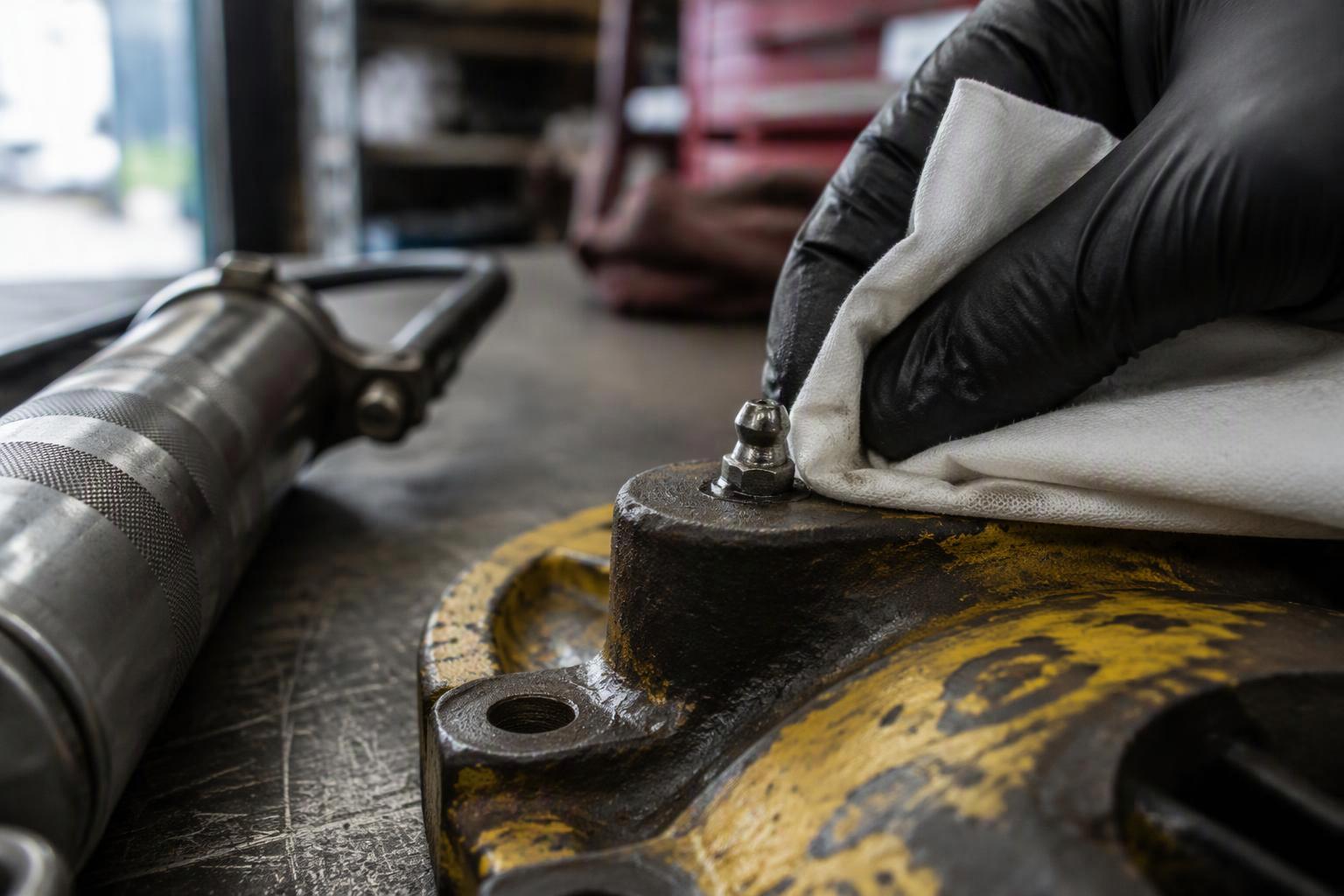
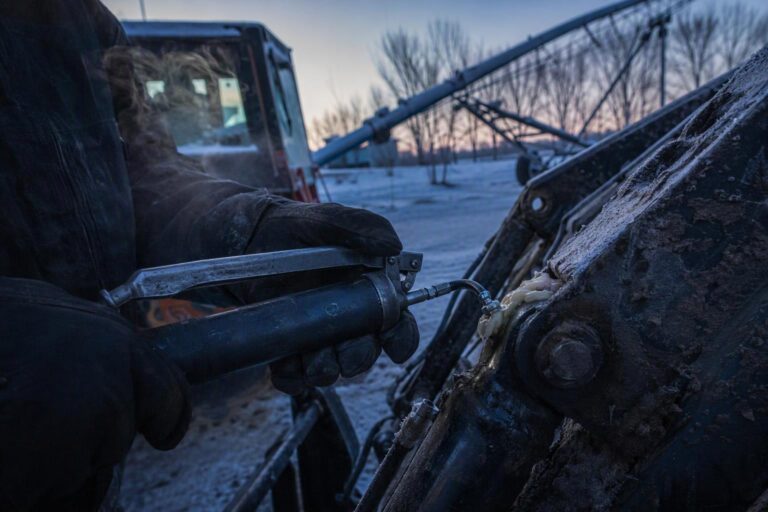
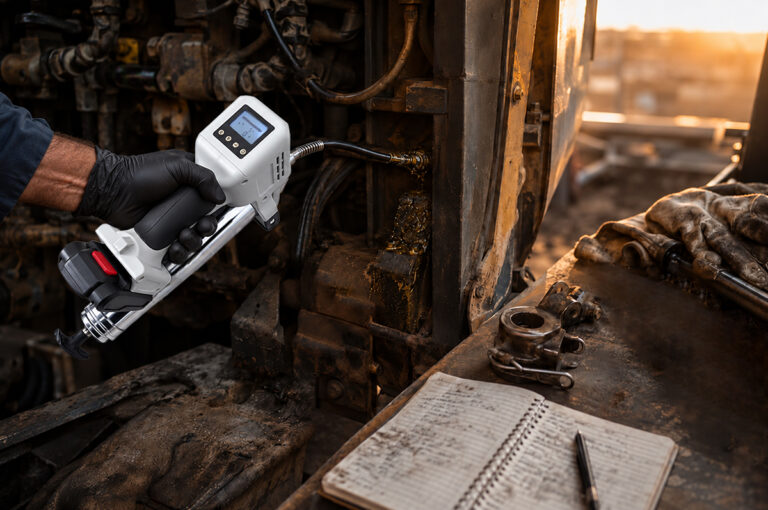
Park the machine on level ground, shut it down, and set the brake before you reach for a rag. Wipe both the coupler jaws and the fitting’s bullneck, because both are sealing surfaces. FLO Components’ MRO technical note states that there are two sealing surfaces for every connection, the jaws of the grease coupler and the bullneck around the head of the fitting, and that both should be wiped clean before lubricating. Most hydraulic couplers seal at any angle up to about 15 degrees, so the coupler is best pushed on at a slight angle and then centred.
Purdue Extension adds the hose end to the wipe list: before pumping grease into the fitting, use a lint-free rag to wipe away dirt, debris, or old grease from around the fitting and from the end of the hose. Engineer Fix points out why the area immediately around the nipple gets the most attention: it is the direct entry point into the joint. Checkpoint: the fitting head and the surrounding boss are free of loose grit, and the coupler jaws are clean.
Step 2: Brush, Pick and Dry the Check-Ball Recess
Scrub the fitting with a stiff wire brush, applying penetrating oil or solvent to the brush for hardened deposits, then wipe it dry. Engineer Fix’s sequence then calls for a small pointed tool, a thin nail or dental pick, to scrape debris from the tiny recessed opening where the ball check valve sits, done carefully to avoid damaging the spring or scratching the ball. Wipe again with a dry cloth so all solvent residue and loosened debris are gone and the fitting is dry before the gun goes on.
Soaking alone will not soften hardened grease, and you cannot poke a wire through a zerk, because the spring and check ball seal it. LaRe’s Skinned Knuckles article confirms the mechanism on a fitting removed from the joint: because a spring and check ball seal the opening, you will not be able to get the wire through the fitting, and soaking will not soften hardened grease. Its alternative is gentle heat from a low-set heat gun or hair dryer to soften old grease, then immediate injection of fresh grease. Checkpoint: the check ball moves freely under light finger or pick pressure, and the recess around it is clear.
Which Cleaning Method Fits Which Type of Buildup?
Match the method to the buildup, and stay conservative on the ball and spring. Engineer Fix’s cleaning guide escalates from rag to wire brush to solvent to pick, and reserves the hydraulic fitting cleaner for a fitting that refuses to accept lubricant at all. A fitting cleaner filled with penetrating oil, tapped rather than hammered, is the tool for a hardened plug in the fitting or the narrow passage behind it.
The conservative rag-only advice from Purdue and Plant Engineering is safer for the ball and spring mechanism. Purdue Extension prescribes a clean rag or shop towel, and Plant Engineering says to carefully remove any dirt or dust from the zerk with a clean rag, warning that failure to do so introduces solids to the bearing with the new grease. Engineer Fix itself cautions that the pick must be used carefully to avoid damaging the spring or scratching the ball.
| Buildup | Method | Caution |
|---|---|---|
| Dust and surface grit | Wipe with a clean rag or lint-free towel | None; do this every time |
| Caked dried grease | Stiff wire brush, solvent on the brush, wipe dry | Keep solvent off painted surfaces |
| Hardened plug at the check ball | Pointed pick in the recess | Do not scratch the ball or bend the spring |
| Fitting will not accept grease | Fitting cleaner with penetrating oil, sharp controlled taps | Never one heavy blow; it damages seals |
| Rock-hard grease in the joint | Low-set heat gun or hair dryer, then inject fresh grease | Do not overheat nearby seals or paint |
Why Won’t My Zerk Fitting Take Grease, and How Does Cleaning Fix It?
When a zerk will not take grease, the cause is usually the fitting itself, not the joint. isohitech’s troubleshooting guide lists the causes in this order: a clogged zerk with the internal ball check stuck on dried grease, a coupler that will not lock, a blocked bearing passage, and grease too stiff for the temperature, with damaged fittings and hardened grease plugs as further causes. No source ranks these by frequency, so treat the list as a checklist, not a ranking.
The symptom tells you which one you are facing. Engineer Fix describes a clogged fitting as immediately apparent when grease begins to leak out the sides of the coupler instead of flowing into the joint, caused by dirt or hardened old grease impeding the internal channel or the seating area of the ball check. That is the same failure the wipe-and-brush routine prevents. If cleaning the exterior and freeing the ball with a careful pick does not restore flow, the fitting is blocked internally or damaged, and the reliable fix is to remove it and install a new one.
How Do I Prevent Fittings From Getting Dirty Again?
Caps and a regular schedule are the two documented defenses. SKF’s TLAC 50/Z grease fitting caps and tags are sold specifically to protect lubrication fittings from external contamination and to identify them by colour coding, in sets of 50 caps and tags with two printable sticker sheets. Engineer Fix notes the same caps in various materials and colours for a colour-coded maintenance system, and adds that frequent lubrication prevents existing grease from sitting idle long enough to harden into the solid plugs that cause clogs.
Caps have limits. Plant Engineering confirms dust caps prevent particle ingress and that colours can identify which grease to apply or how often a point should be relubricated, but adds that caps are inexpensive with a short life expectancy, degraded by sunlight, washdowns, and traffic, and that all dust caps should be inspected frequently to ensure they still protect the fitting. Purdue Extension adds the post-greasing step: wipe off excess grease after application to avoid dirt and debris adhering to the outside surface, and check the manual for how often and how much, recording the date each time you grease.
FAQ
Can I just wipe the tip and start pumping?
No. The tip is one of two sealing surfaces, and the recess around the check ball is where debris blocks flow. FLO Components states that both the coupler jaws and the fitting bullneck should be wiped clean before lubricating, and Engineer Fix calls cleaning the exterior before attaching the gun an absolute requirement.
Why does grease leak around the coupler instead of going in?
Many seasoned maintenance technicians note that grease escaping from coupler sides typically signals a clogged Zerk fitting. Dirt and hardened grease often block the inner channel or check‑ball seat. Dirty fitting necks or worn coupler jaws can also break the seal. Wipe both surfaces, connect the coupler at a slight angle, then center it securely.
Will soaking a clogged fitting in solvent clear it?
Many seasoned maintenance technicians point out that soaking alone cannot soften hardened grease. The spring and check‑ball inside Zerk fittings prevent wire cleaning, and soaking does little for solidified old grease. Use low‑heat from a heat gun or hair dryer to soften old grease, then inject fresh grease immediately.
Is compressed air okay for blowing out a fitting?
Only below 30 psi, and never on yourself. OSHA 1910.242(b) permits compressed air for cleaning only where reduced to less than 30 psi with effective chip guarding and personal protective equipment, and an OSHA interpretation adds that employers should not allow compressed air to clean employees or their clothing.
How much pressure does a grease gun put on a fitting?
Far more than the fitting needs to open. SKF’s 2026 grease gun brochure rates its manual guns at 300 to 400 bar (4,350 to 5,800 psi) and its LAGC S coupler at 550 bar (8,000 psi). SAE J534 requires the check valve to open at no more than 3.1 MPa, roughly 450 psi, so the gun has ample pressure to force whatever sits on the fitting into the channel.
Should I replace the fitting or keep cleaning it?
Clean it first, replace it if cleaning fails. Engineer Fix advises that for fittings that remain completely blocked, the most reliable approach is to remove the fitting and replace it with a new one, cleaning the exposed lubrication channel before installing the replacement. A damaged, seized, or cross-threaded fitting is a replacement case from the start.
Do grease fitting caps actually help?
Yes, with inspection. SKF’s product data lists fitting caps and tags as protection against external contamination with colour-coded identification, and Plant Engineering confirms caps prevent particle ingress but warns they have a short life expectancy in sunlight, washdowns, and traffic, so they need frequent inspection.
Why does the fitting have a spring and ball inside at all?
It is a one-way valve that keeps grease in and dirt out. U.S. patent US1697217A describes the ball closure held by a compression spring against the port, and Purdue Extension explains that the spring and ball serve as a mechanical shield to keep dirt and water out of the channel and keep the grease inside. SAE J534 requires that check valve on all standard hydraulic lubrication fittings.
Conclusion
A fitting that takes grease on the first pump is a fitting you cleaned before you coupled up. The sequence is short: wipe the fitting and the coupler jaws, brush with solvent for caked deposits, wipe dry, then pick the check-ball recess until the ball moves freely. Purdue Extension gives the reason the order matters, and SKF’s failure split gives the reason it is worth the few minutes: poor lubrication and contamination together account for well above half of premature bearing failures. When cleaning does not restore flow, replace the fitting rather than forcing grease past a blockage. Keeping greased heavy equipment fueled and running between services is easier with the right on-site diesel refueling and fuel transfer equipment, which supports a maintenance schedule that does not slip.