
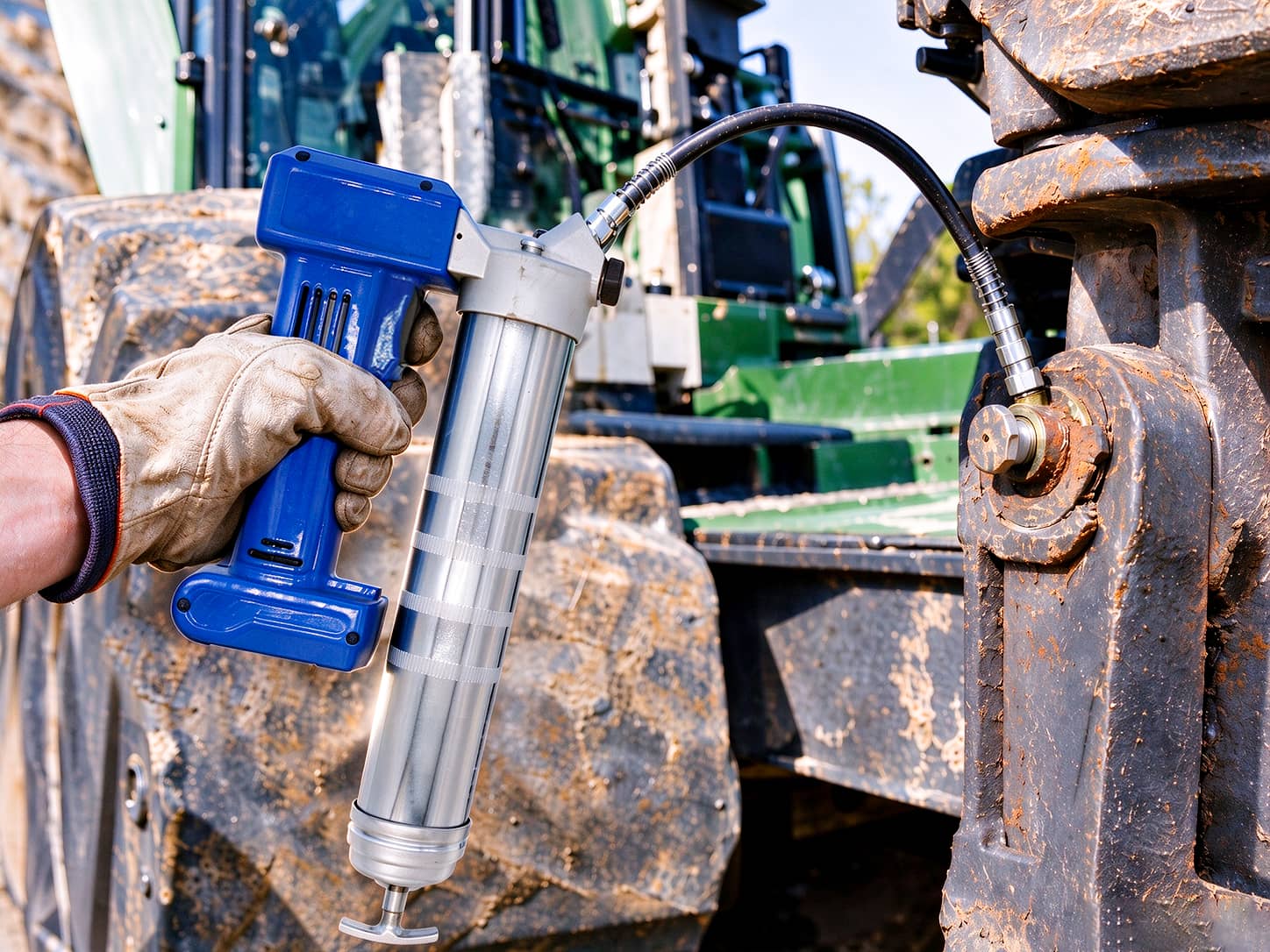

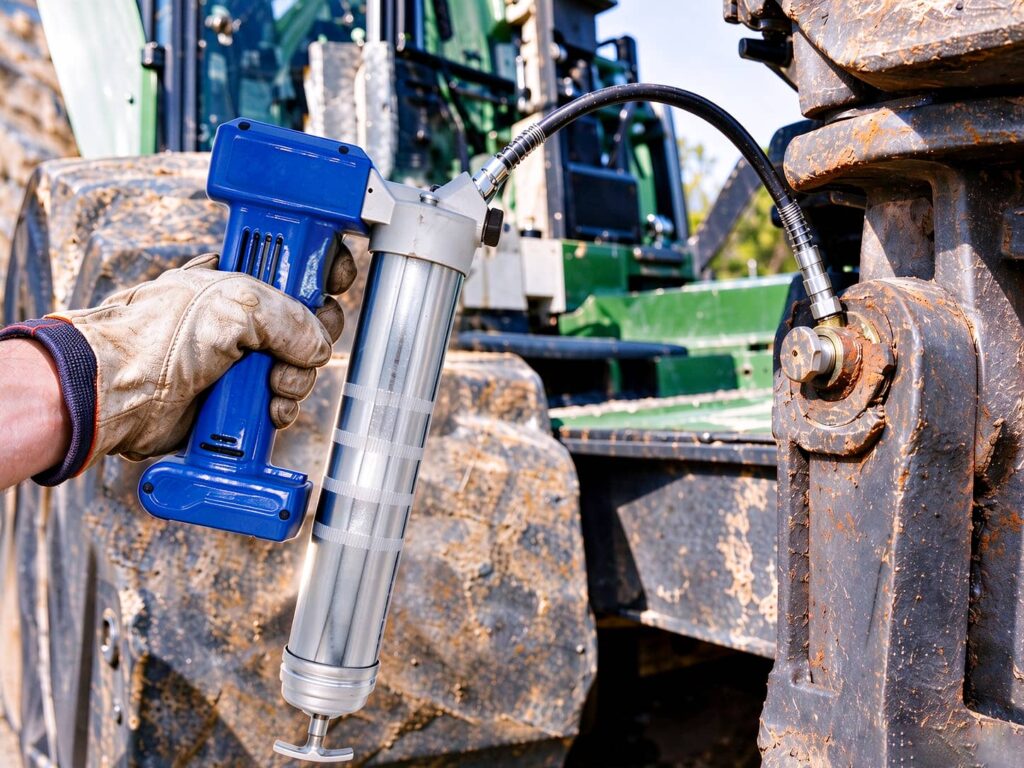
A grease gun is one of the cheapest tools you own, and one of the most valuable. It keeps a tractor loader greasing point happy, a fifth wheel sliding instead of grinding, and an excavator bucket pin turning instead of seizing. But the right gun for a hobby tractor is rarely the right gun for a construction crew running daily shifts.
This guide walks through how to choose a grease gun based on the machines you actually run, the fittings they have, the grease they call for, and how you grease in practice. It ends with a short buying checklist so you can walk into the decision with a clear picture.
Key Takeaways
- Match the gun to the job, not the brand. A manual gun handles most farm and light-duty work; a cordless or pneumatic gun earns its keep on high-volume fleets.
- Output and pressure matter more than price. Lever guns pump the most pressure per stroke, which helps on stubborn fittings.
- The coupler must fit the fitting. A standard or button-head zerk needs a coupler that locks on cleanly, or you’ll fight leaks all day.
- Buy for your maintenance interval. Equipment that needs grease every 8–10 hours justifies a battery or pneumatic gun more than a pickup greased every few thousand miles.
Start With What You’re Actually Greasing
Before you compare barrel sizes and max psi, take stock of the equipment you run and the fittings it has. The decision starts here.
Count the zerks and how often they get serviced
Think through three questions:
- How many fittings are on your highest-use machine? A compact tractor may have twenty; a full-size combine or a truck-and-trailer setup can have far more.
- How often are they greased? Pins and bushings on loaders and excavators typically need grease every 8–10 operating hours; swing bearings and track rollers stretch to 50 hours or more.
- Where does the work happen? Field work away from a compressor points to a manual or cordless gun; a shop-based fleet can lean on pneumatic.
If you grease a handful of points once a month, a manual pistol-grip gun is plenty. If you’re hitting dozens of fittings daily, the extra cost of a cordless or pneumatic gun pays for itself in time saved.
Pro Tip: Keep a spare grease-gun coupler in the toolbox. Couplers wear out faster than almost anything else on the gun, and a worn coupler is the usual reason grease leaks around the fitting instead of going in.
The Main Types of Grease Guns
Grease guns come in three power flavors — manual, battery-powered, and pneumatic — with manual split into two distinct grips.
Manual: lever and pistol-grip
Manual guns are the workhorses. A lever gun is pumped with a two-hand squeeze, develops the highest pressure of the manual styles, and is the go-to when a fitting is stubborn, seized, or hard to reach. A pistol-grip gun runs on a one-hand trigger, is easier in tight spaces, and suits fast, repetitive greasing on points that aren’t fighting back.
Battery powered: cordless grease guns
A cordless grease gun runs on a rechargeable battery and delivers pressure at the pull of a trigger, which removes most of the hand fatigue. It’s the right tool when you service machines in the field, away from a compressor, or when you have a long string of fittings to hit on a loader, excavator, or truck-and-trailer.
Pneumatic: air powered
Pneumatic grease guns plug into an air compressor and run continuously, making them fast and efficient for shop-floor work. They’re lightweight and don’t run out of charge, but they’re tethered to a hose and a compressor, so they’re not a field tool.
If you maintain several machines under one roof, a pneumatic gun is hard to beat for speed. If you’re greasing out in a pasture, a battery gun wins.
Key Takeaway: For a farm or light fleet, one good manual gun covers most work. Add a cordless or pneumatic gun when you have enough fittings or volume that time and fatigue start costing you.
How to Evaluate a Grease Gun: What Actually Matters
Once you’ve settled on a power type, focus your comparison on a handful of specs that determine how the gun behaves on your equipment.
Max pressure and grease gun psi
Pressure is what forces grease through a snug fit and past crusty old grease. A higher max rating helps on seized or heavily loaded fittings, which is why lever guns get picked for stubborn zerks. Don’t get hung up on chasing the highest number — more pressure than the joint needs can force the seal out. Match the gun’s pressure to how hard your fittings actually are to grease.
Output per pump
Output tells you how fast the gun moves grease. Higher output per stroke speeds up big jobs, but pump it too fast into a small bearing and you risk blowing out a seal. If you grease by feel, pump in small, controlled increments and watch for fresh grease to appear at the joint.
Capacity and how it loads
Most guns hold about 13–16 ounces of grease. Higher capacity means fewer refills on a long pass over the fleet. Guns load three ways: from a grease cartridge, by drawing grease out of a bulk bucket with a suction follower, or by packing the barrel by hand. Cartridge loading is the quickest on a jobsite; bulk loading is cheaper when you go through a lot of grease.
Coupler and hose
This is where the grease gets from the gun into the fitting. The coupler has to lock onto your zerk type securely — a standard zerk, or a heavier button-head fitting used on denser, heavy-duty connections — or grease pushes past the tip and nothing goes in. A flexible hose, and a longer one where you reach across a loader or into a truck chassis, makes fittings far more accessible.
⚠️ Warning: If a fitting won’t take grease, don’t just crank up the pressure. That pushback often means a blocked or damaged zerk, hardened grease, or a failed seal — more force can snap the fitting off or blow the seal. Clear the fitting before you lean on the gun.
Match the Gun to the Grease
A grease gun only works as well as the grease you put in it. Pick the wrong consistency or chemistry and the gun fights you, or the point wears out prematurely. Two decisions matter: the NLGI consistency grade and the grease’s chemistry.
Lithium vs moly
Chemistry matters as much as consistency. Lithium and lithium-complex EP grease is the general-purpose baseline — it balances water resistance, pumpability, and load capacity, which is why it’s the default for chassis and agricultural work. Moly grease, which adds molybdenum disulfide, is built for boundary lubrication: pins, bushings, kingpins, fifth wheels, U-joints, and other slowly moving, heavily loaded joints that take shock and oscillation. Graco’s moly-versus-lithium explainer walks through when each fits.
A useful rule of thumb: run #2 lithium-complex EP across the fleet, and keep a tube of #2 lithium-complex with moly for loaders, backhoe pivots, and fifth wheels. Use food-grade H1 grease only where a fitting sits near crops, feed, or other incidental food contact — anywhere else it’s unnecessary cost. And check your owner’s manual before anything; OEM guidance overrides any general rule.
The Interval Sets the Gun You Need
Greasing isn’t a chore you do because the manual says so. It’s the cheapest insurance against downtime. Heavy equipment depends on a thin grease film to keep metal from grinding on metal, and when that film disappears, bearings and bushings fail fast.
A single lubrication failure on construction equipment runs around $85,000 on average, and inadequate greasing contributes to a large share of preventable bearing and component failures, according to Heavy Vehicle Inspection’s greasing-machinery maintenance guide. On a farm, the cost shows up as a machine that fails in the middle of harvest. A good grease gun and a few minutes with it is far cheaper.
| Equipment | Typical interval | What it means for your gun |
|---|---|---|
| Loader/excavator pins & bushings | Every 8–10 operating hours | Daily greasing; a cordless or pneumatic gun saves your hands and your time |
| Tractor points (pins, PTO, loader) | About every 10 hours of use | A reliable manual lever gun is usually enough |
| Swing bearings, track rollers | Every 50–100 hours | Less urgent; any manual gun works |
| Light-duty truck chassis | Every 3,000–5,000 miles | A manual pistol-grip covers routine greasing |
| Heavy/harsh-duty truck | Every 1,000–2,000 miles | A battery gun earns its keep on frequent maintenance |
These figures come from FieldFix’s heavy-equipment grease-point guide and Piston Revolutions’ truck-and-trailer greasing schedule. Always fall back to your owner’s manual, and grease more often in dust, mud, heavy loads, or heat — and hit dried-out points at the end of the day so the fresh grease protects seals overnight.
A Short Buying Checklist for a Grease Gun
Before you hand over the cash, run through these seven boxes. Each one maps to a decision we’ve covered:
- Power matches your volume and location. Manual for light duty; cordless or pneumatic for daily, high-volume or field work.
- Pressure fits your fittings. Lever guns for stubborn or seized zerks; don’t chase max psi you don’t need.
- Output is controlled enough to avoid over-greasing. You want to pump in increments and stop when fresh grease shows at the joint.
- Capacity and loading suit your routine. Cartridge loading for speed, bulk loading to save money at high volume.
- Coupler locks onto your zerk. Confirm standard or button-head and keep a spare coupler on hand.
- Hose reaches your fittings. Longer, flexible hoses make loaders, trucks, and excavators far easier to grease.
- It handles the grease you run. #2 lithium-complex EP as the baseline, with a moly tube for pins, bushings, and fifth wheels.
FAQ
Do I need a cordless grease gun, or is manual fine?
Manual is enough for a small farm or light-duty routine. Go cordless when you grease many fittings daily, work in the field, or want to avoid hand fatigue. Pneumatic is the better bet if you’re anchored to a shop with compressed air.
What grease do I put in it?
Start with an NLGI #2 lithium-complex EP grease for tractors, trucks, and general farm equipment. Keep a moly grease for pins, bushings, kingpins, and fifth wheels, and use food-grade H1 only near food or feed contact.
How often should I grease my tractor or truck?
Follow the owner’s manual first. As a baseline, loader and excavator pins and bushings need grease every 8–10 operating hours, tractor points about every 10 hours, and truck chassis every 1,000–5,000 miles depending on duty.