
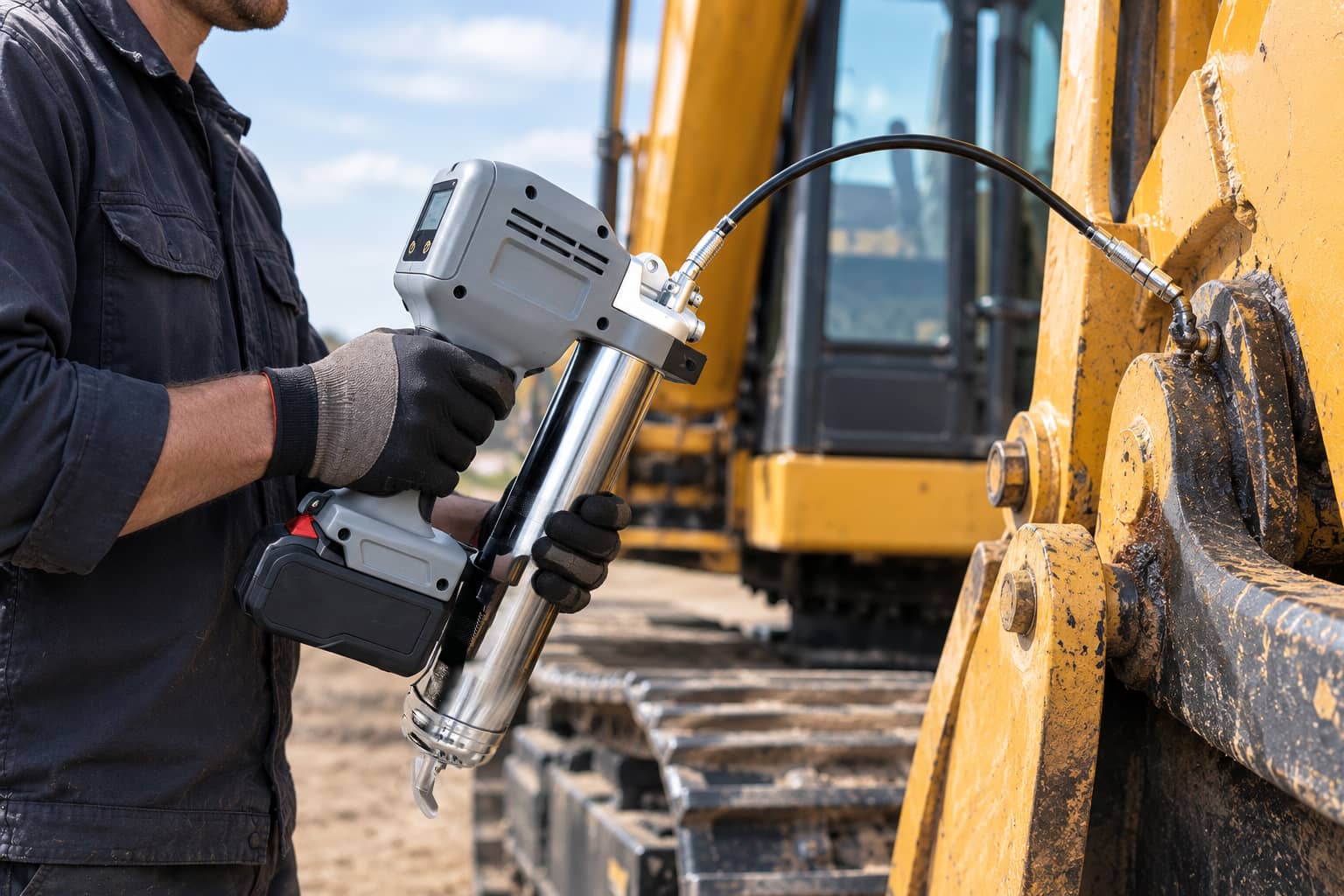

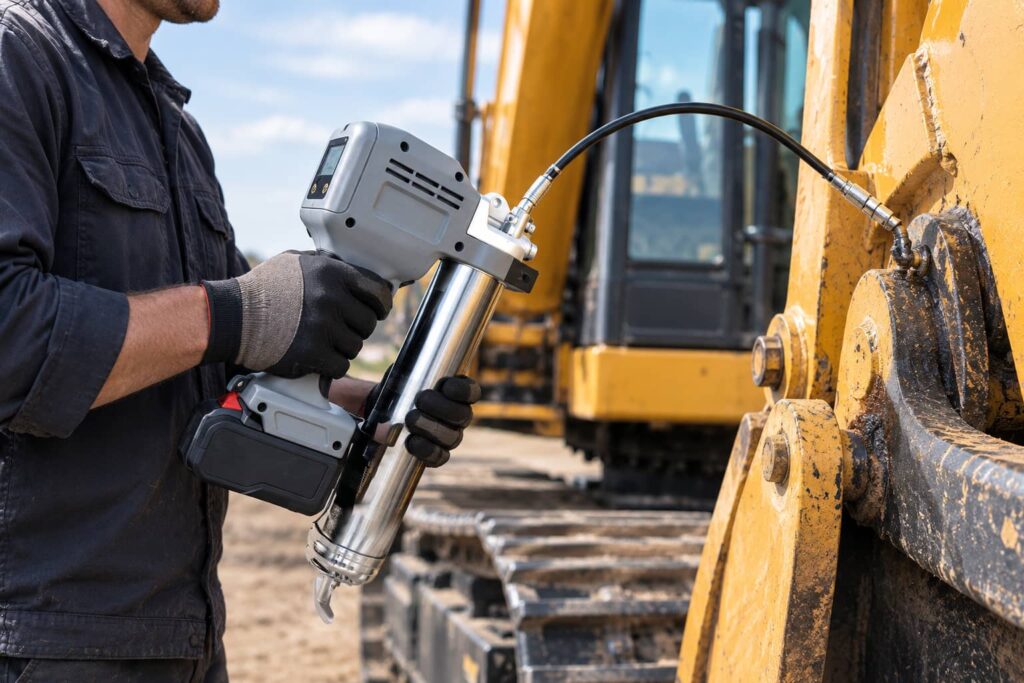
A grease gun is the cheapest insurance you own for farm and heavy equipment — and the most commonly abused. A loader pin that goes dry stops a whole machine, while a gun that won’t pump just wastes your afternoon. Picking the right one is half the job; knowing how to prime and bleed it is the other half.
This guide narrows the best cordless and manual grease guns to the models worth your money, gives you a straight spec comparison, and then walks through exactly how to prime and bleed whatever you end up running.
Key Takeaways
- Pressure beats speed on stubborn fittings. Higher psi forces grease past old, crusty grease; a cordless gun’s output rate is about speed, which matters mainly on big jobs.
- Priming is about letting air escape. Slightly loosen the barrel or open the bleeder valve, pump until bubble-free grease flows, then tighten and test.
- A gun that ‘won’t pump’ is almost always an air lock — fixable in under a minute with the right bleed.
How These Picks Are Made
Before the recommendations, here are the criteria. Every model below was judged on the four things that decide whether a grease gun actually helps you:
- Max pressure (psi) — how hard the gun pushes grease through a snug, seized, or clogged fitting.
- Output rate and stroke — how fast it moves grease; critical for big machines, less so for a handful of zerks.
- Reach (hose length) and capacity — whether the gun can get to fittings on a loader bucket, truck chassis, or combine without constant reloading.
- Practical fit for your routine — battery platform, weight, ease of priming, and whether the cost is justified by how often you grease.
The prices for these tools shift constantly, so this guide frames value by tier — budget, mid, and pro — rather than quoting a dollar figure that goes stale. You’ll pay more for a pro cordless kit than a budget manual gun, and the guide says plainly when the extra money is wasted on your setup.
Best Cordless Grease Guns
Cordless guns trade hand fatigue and pumping speed for a heavier tool that needs a charge. If you grease several machines in the field or run dozens of fittings a day, the time they save is real. Here are the strongest picks, with the verified specs stacked side by side.
| Model | Max PSI | Flow rate | Grease capacity | Battery / platform | Best for |
|---|---|---|---|---|---|
| C200 | 10000PSI | 200g/min | 400g/500g | 21V 2.0AH/4.0AH lithium battery | Best all-around cordless for farm, fleet, construction |
| C21 | 10000PSI | 120g/min | 400g/500g | 21V 2.0AH/4.0AH lithium battery | Best heavy-duty; longest hose for big equipment |
| C15 | 10000PSI | 120g/min | 400g/500g | 2.0AH lithium battery | Best compact / light for tight spaces |
| C8 | 8000PSI | 80g/min | 400g | 18V 2.0AH lithium battery | Solid mid-weight option |
| C6 | 8000PSI | 80g/min | 400g | 18V 2.0AH lithium battery | Best budget cordless |
C200
- 21V Lithium battery 2.0/4.0AhMax. pressure 10000PSI
- Flow rate: Can set as your requirements
- Cartridge capacity:400/450g
- Bulk capacity: 450/500g
- Charger: 110-240VAC
- Charge time: 60+10minAnti-spring flexible hose4jaws nozzle
- 3pcs in one carton: 66+38*48cm 22kgOne 20GP can load 1170pcs
Advantage:
- 1.Accurate Flowmeter to read the working status.
- 2.Save your grease by presetting the grease volume.
- 3.Free your hands by self-working without touch the trigger.
- 4.Explosion-proof by using a brushless motor.
- 5.High pressure 10000PSI and flow rate 200g/min for heavy duty working
C21-21V with LCD display
- 21V-2.0Ah Lithium ion battery
- LCD display for real time reading:
- Battery level
- High/Low speed
- 10000PSI (689bar) max.
- Grease out put
- Flow rate:
- H:140±10g/min
- L: 100±10g/min
- 3 points standing
- Anti-Spring flexible hose
- 4jaws nozzle
- Blow case size: 65*36*16cm
- Carton size(3pcs in):66*38*48cm
- 20GP load:300pcs
C8 -37.99
- 2.0Ah Lithium ion battery inside
- Clear plastic tube to see the remaining grease level
- 8000PSI high pressure
- 80g/min high flow rate
- Easy greasing the equipment
- Type C USB charging with phone charger adapter
- Flexible and steel hose
- 4Jaws nozzle and tip nozzle
- Package: carton size 45*24*11cm per set
- Color: Red, blue, yellow, black
- OEM customized requirements available
- OEM Brand sticker free
How to Prime and Bleed a Grease Gun
A new gun, a fresh cartridge, or a gun that’s been sitting in the truck all load with air trapped in the barrel and delivery system. If you don’t bleed it, you’ll pump the handle and nothing comes out — that’s called an air lock. The fix is simple: give the air an escape route, then pump until solid, bubble-free grease flows from the coupler.
Cordless grease guns
- Load the cartridge or bulk grease and pull the follower rod, engaging it so grease presses forward.
- Depress the bleed valve while pushing the follower rod — this drives trapped air out through the valve.
- Run the gun several times until grease flows freely and steadily. Some models use a loosened air-drain valve while cycling, then you tighten it once grease appears.
If the gun won’t pump
Work through these in order — an air lock is the usual culprit, not a broken tool:
- Reopen the bleeder or loosen the barrel, then pump until grease appears. If the head was fully tight during priming, air had nowhere to go.
- Make sure the follower rod is pressurizing. Lock it and let it push the grease forward; without that pressure, nothing moves.
- Check the coupler and nozzle for clogs. A blocked tip or a coupler that won’t lock onto the zerk pushes grease past the fitting instead of into it.
- Warm up the grease. Cold grease (and cold grease guns) flows poorly — leaving the tube near a heater for a bit can make priming far easier.
- Pump longer and tap the barrel. Some guns need two or three purge cycles to clear every pocket of air.
⚠️ Warning: Keep the coupler pointed away from your body when priming. Machinery Lubrication’s guide to operating a grease gun safely stresses that trapped air can push grease out under pressure — aim it at a rag or waste surface, not at your hands.
FAQ
What psi should a grease gun have?
Enough to push grease through your fittings. Heavy-duty guns rate at 10,000 psi, but you don’t always need max pressure — a gun’s pressure should match how hard your fittings are to grease. Lever guns are picked when fittings are stubborn.
How do I get the air out of my grease gun?
Loosen the barrel a turn or two (or open the bleeder valve), hold the nozzle up, and pump until bubble-free grease flows, then tighten and test. For cordless models, depress the bleed valve while running the gun.
Why won’t my grease gun pump?
Almost always an air lock. Reopen the bleeder or loosen the barrel and pump until grease appears, confirm the follower rod is pushing grease, and clear any clogged coupler. Cold grease also thickens and resists pumping.
Next Steps: Keep Your Machines Fueled and Greased
Picking a grease gun that primes cleanly is one half of dependable equipment — the other half is a routine that keeps your machines ready when they’re needed. That’s why putting fueling and maintenance in the same place pays off: it means the same crew that greases a loader can refill it on site instead of waiting on a truck. Portable diesel transfer tanks and a quality 12V transfer pump make that setup practical for a farm or crew, keeping fuel and grease where the work happens.